Tuesday, October 8, 2019

Ahiqar and Ahi-yaqar


 The Rabshakeh and his men outside the wall of Jerusalem

 
by
 
Damien F. Mackey


“… if Ahiqar was not an ethnic Assyrian, he had evidently not only mastered the complicated cuneiform scribal art and absorbed the Assyrian culture in full, but also had gained the trust of his masters and the respect of the other courtiers for his wisdom”.
 
Takayoshi M. Oshima


Ahikar (or Achior in the Vulgate), the nephew of Tobit of the Israelite tribe of Naphtali, was a man of many parts, having famously served as a high official under Sennacherib - as the “Achior”, commander of the Elamites (not Ammonites), of the Book of Judith - then as second (ummânū) to Esarhaddon himself, who was Nebuchednezzar ‘the Great’. See e.g. my article:
 
Esarhaddon a tolerable fit for King Nebuchednezzar
 
https://www.academia.edu/38017900/Esarhaddon_a_tolerable_fit_for_King_Nebuchednezzar
 
and who may also have been the “Bagoas” of the Book of Judith:
 
An early glimpse of Nebuchednezzar II?
 
https://www.academia.edu/38114479/An_early_glimpse_of_Nebuchednezzar_II
 
Ahiqar was also known as “Arioch” (Judith 1:6): “Many nations joined forces with King Arphaxad—all the people who lived in the mountains, those who lived along the Tigris, Euphrates, and Hydaspes rivers, as well as those who lived in the plain ruled by King Arioch of Elam. …”.
“Governor”, or “commander”, would probably be more accurate here than “King”, though did not Sennacherib boast (Isaiah 10:8): ‘Are not my commanders all kings?’
As “Arioch”, Ahiqar figures again in the Book of Daniel. See e.g. my article:
 
Meeting of the wise - Arioch and Daniel
 
https://www.academia.edu/40551289/Meeting_of_the_wise_-_Arioch_and_Daniel
 
 
In Takayoshi M. Oshima’s article, “How “Mesopotamian” was Ahiqar the Wise? A Search for Ahiqar in Cuneiform Texts”, we learn that the famous sage, Ahiqar, was also known by this, his original, name, Ahī-yaqar. On p. 144 (section “Ahiqar in Cuneiform Texts from the 7th Century BCE”), we read:
https://www.academia.edu/34084863/How_Mesopotamian_was_Ahiqar_the_Wise_A_Search_for_Ahiqar_in_Cuneiform_Texts_Berlejung_Maeir_and_Sch%C3%BCle_eds_Wandering_Arameans_Arameans_Outside_Syria
 
Ahiqar in Cuneiform Texts from the 7th Century BCE According to the Ahiqar narrative, Ahiqar served the Assyrian kings Sennacherib and Esarhaddon as a high-ranking courtier, specifically as cupbearer, seal-holder, scribe, counsellor and treasurer. If this is true and if Ahiqar was not an ethnic Assyrian, he had evidently not only mastered the complicated cuneiform scribal art and absorbed the Assyrian culture in full, but also had gained the trust of his masters and the respect of the other courtiers for his wisdom. In order to verify this account, the obvious thing to do is to seek for an individual called Ahiqar or the like in the cuneiform texts from the time of Sennacherib and Esarhaddon. And indeed we do find references to a man or men bearing the name Ahīyaqar.16 Thus, SAA 6, no. 123, line 1 (dated to 698, in the reign of Sennacherib) refers to an Ahī-yaqar, deputy governor of Arrapha (modern Kirkūk). The text SAA 6, no. 246, refers to a certain Ahī-yaqar who acted as a witness for a slave-sale (reign of Esarhaddon), but unfortunately his title has been lost (rev. 3). Furthermore, in SAA 6, no. 287 (dated to 670, in the reign of Esarhaddon), the name Ahī-yaqar appears as an eponym of the village Kapar-Ahī-yaqar (lit.: the village of Ahī-yaqar) that was located near Sippar (line 12). Finally, a man called Aqru is known from SAA 14, no. 215, rev. 10.17 Aqru is the adjective of the Akkadian waqāru, a cognate of yāqar, but the name could be a hypocoristic form of Ahī-yaqar. According to this text, Aqru was a cupbearer and citizen of Nineveh, just like Ahiqar in the legend. These references indeed prove that one or several persons called Ahī-yaqar existed and held important positions in the 7th century Assyrian administration .... because
 
And on p. 149 of the same article, we learn of “Ahiqar in the Uruk List of Sages”.
 
King Sage Designation Ayalu U4- dAn(60) abgal Alalgar U4- dAn(60)-du10.ga abgal Ammeluanna En.me-du10.ga abgal Ammegalanna En.me-galam.ma abgal Enmeušumgalanna En.me-bùlug.gá abgal Dumzi dAn(60)-en.líl.da abgal Enmeduranki Ù.tu-abzu abgal (Flood) Enmerkar Nun.gal-pirìg.gal abgal [Gilgam]eš dSîn(30)-lēqi(TI)-unninni(ÉR) lúummannu [Ibb]i-Sîn Kabtu(IDIM)-il-dMarduk(ŠÚ) lúummannu [Išbi]-Erra Si-dù = dEn-líl-ibni(DU) ummannu [Ab]i-Ešuh Gimil(ŠU)-dGula(ME.ME) and Ta-qišdGula(ME.ME) ummannū [Adad-apla-iddina? ] É-sag-gíl-ki-i-ni-apli(IBILA) ummannu Adad-apla-iddina É-sag-gíl-ki-i-ni-ub-ba ummannu Nebuchadnezzar (I) É-sag-gíl-ki-i-ni-ub-ba-LU43 ummannu Esarhaddon A.ba-dNINNU(5044-da-ri ummannu [šá lú]aḫ-la-«MI»-mu-ú i-qab-bu-ú ma-ḫu-ʾi-qa-a-ri45 [x(x)]x46 mni-qa-qu-ru-šu-ú (Nikarchos?) ....
Figure 10: Names and their definition in the Uruk List.
 
Some of these names may be duplicates, though, because of the need to fold, e.g. Middle and Neo Assyro-Babylonian history.
Thus, Nebuchednezzar I and his ummânū, É-sag-gíl-ki-i-ni-ub-ba, need to be folded (I think) with, respectively, Esarhaddon and his ummânū, a-ḫu-ʾi-qa-a-ri (or A.ba-dNINNU), that is, Ahī-yaqar (Aba-enlil-dari).
 
John Day, Robert P. Gordon, Hugh Godfrey Maturin Williamson write about the important sage, Ahiqar, in Wisdom in Ancient Israel, pp. 43-44:
 
The figure of Ahiqar has remained a source of interest to scholars in a variety of fields. The search for the real Ahiqar, the acclaimed wise scribe who served as chief counsellor to Sennacherib and Esarhaddon, was a scholarly preoccupation for many years. …. He had a sort of independent existence since he was known from a series of texts – the earliest being the Aramaic text from Elephantine, followed by the book of Tobit, known from the Apocrypha and the later Syriac, Armenian and Arabic texts of Ahiqar. …. An actual royal counsellor and high court official who had been removed from his position and later returned to it remains unknown.
 
Mackey’s comment: I have also identified this Ahiqar (var. Achior, Vulgate Book of Tobit) as the “Achior” (and also the “Arioch”) of the Book of Judith; and as the “Arioch” of the Book of Daniel.
Day et al. continue:
 
…. E. Reiner found the theme of the 'disgrace and rehabilitation of a minister' combined with that of the ‘ungrateful nephew’ in the 'Bilingual Proverbs’, and saw this as a sort of parallel to the Ahiqar story.
 
Mackey’s comment: For my identification of the ‘ungrateful nephew’, Nadin (var. Nadab), see my article:
 
"Nadin" (Nadab) of Tobit is the "Holofernes" of Judith
 
https://www.academia.edu/36576110/_Nadin_Nadab_of_Tobit_is_the_Holofernes_of_Judi
 
Day et al. continue:
 
…. She [Reiner] also emphasized that in Mesopotamia the ummânu was not only a learned man or craftsman but was also a high official.
 
At the time that Reiner noted the existence of this theme in Babylonian wisdom literature, Ahiqar achieved a degree of reality with the discovery in Uruk, in the investigations of winter 1959/60, of a Late Babylonian tablet (W20030,7) dated to the 147th year of the Seleucid era (= 165 BCE).
 
Mackey’s comment: For my proposed radical revision of this Seleucid era, see my article:
 
A New Timetable for the Nativity of Jesus Christ
 
https://www.academia.edu/36672214/A_New_Timetable_for_the_Nativity_of_Jesus_Chri
 
Day et al. continue:
 
…. This tablet contains a list of antediluvian kings and their sages (apkallû) and postdiluvian kings and their scholars (ummânu). The postdiluvian kings run from Gilgamesh to Esarhaddon. This text informs us (p. 45, lines 19-20) that in the time of King Aššur-aḫ-iddina, one A-ba-dninnu-da-ri (= Aba-enlil-dari), (whom) the Alamu (i.e., Arameans) call Aḫ-'u-qa-ri (= Aḫuqar), was the ummânu. As was immediately noted, Aḫuqar was the equivalent of Aḥiqar. ….
The names of the ummâof Sennacherib and Esarhaddon are known to us from a variety of sources, but Ahiqar's name does not appear in any contemporary source. ….
 
Mackey’s comment: But what is actually “contemporary” may now need to be seriously reconsidered if there is any weight to my series:
 
Aligning Neo Babylonia with Book of Daniel. Part One: Shortening the Chaldean Dynasty
 
https://www.academia.edu/38330231/Aligning_Neo_Babylonia_with_Book_of_Daniel._Part_One_Shortening_the_Chaldean_Dynasty
 
Aligning Neo-Babylonia with Book of Daniel. Part Two: Merging late neo-Assyrians with Chaldeans
 
https://www.academia.edu/38330399/Aligning_Neo-Babylonia_with_Book_of_Daniel._Part_Two_Merging_late_neo-Assyrians_with_Chaldeans
 
Day et al. continue:
 
Indeed, it has been recently claimed that the passage from the Uruk document 'is clearly fictitious and of no historical value’, for A-ba-dninnu-da-ri was the name of a scholar known from the Middle Babylonian period.
 
Mackey’s comment: That is exactly what I would expect to find, the sage ummânu existing in both the so-called Middle and the neo Assyro-Babylonian periods, due to a necessary as demanded by revision) folding of the Middle into the later period.
Day et al. continue:
 
…. Yet, the listing of Ahiqar in a Late Babylonian tablet testifies to the fact that the role of Ahiqar, as known from the Aramaic version found at Elephantine, the book of Tobit, and the later Ahiqar sources, was firmly entrenched in Babylonian tradition.

Thursday, October 3, 2019

Ramses II and “Tree of Life”


Ramses II, Tree of life, Karnak


by
 
Damien F. Mackey


“On the western wall is a scene depicting Ramesses II getting his name recorded on the tree of life by the God Thoth and the Goddess Seshat, to ensure a long, everlasting life”.


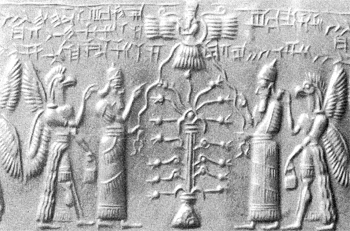
Not surprisingly, if Ashurbanipal were Nebuchednezzar as I have been suggesting, then ‘the king as a sheltering Tree of Life’, an image from the Book of Daniel (4:20-22):
 
 
‘The tree you saw, which grew large and strong, with its top touching the sky, visible to the whole earth, with beautiful leaves and abundant fruit, providing food for all, giving shelter to the wild animals, and having nesting places in its branches for the birds— Your Majesty, you are that tree! You have become great and strong; your greatness has grown until it reaches the sky, and your dominion extends to distant parts of the earth’,
 
can be found as a description of Ashurbanipal, he being like a ‘cosmic tree’.
See my article:
 
Ashurbanipal, Manasseh, Necho I-II, Nebuchednezzar. Part Two (ii): Ashurbanipal as Nebuchednezzar, "Cosmic Tree"
 
 
Ramses II in Tree of Life
 
Now one finds also that pharaoh Ramses II, who I believe to have been a contemporary of this era – a view pioneered by Dr. Immanuel Velikovsky (though I do not necessarily accept Velikovsky’s equation of Ramses with Necho) – was indeed associated with the Tree of Life.

....
 

The Tree of Life
Picture of the Tree of Life

The picture of the Tree of Life depicts a scene from the tomb of Ramses II in which his name is recorded and inscribed on the leaves of the tree of life
  • The ever youthful figure pictured in the Tree of Life is the Pharaoh Ramses II, depicted with his symbols of kingship: crown, flail and scepter

  • The figure to the left is the ibis headed god Thoth who was the god of wisdom, magic, and the measurement, and regulation, of events, and of time. He was the secretary of  the sun god Ra and scribe of the Underworld and inscribed the name of the Pharoah on the Tree of Life

  • The first god on the right of the picture is Ptah, the lord of truth and master of justice who was present at the ceremony of justification in the Hall of the Two Truths
    The goddess on the right of the picture is Tefnut, the lion headed goddess of water, is often depicted on the coffins of the deceased pouring drink from a pitcher, to sustain the souls journeying through the Underworld. She was also one of the 42 judges present at the ceremony of justification


.... The Ramesseum houses a Hypostyle hall which is a grand interior space where pillars and columns hold up the roof. Presently, 29 columns still stand in the Ramesseum’s Hypostyle hall. To allow in light, the middle columns are shorter than the outer edge columns. It also featured traceried windows. Depicted on the columns are additional scenes of the Battle of Kadesh.
 

© Daniel & Kate - Ramesseum Hypostyle Hall Columns
 
Two rows of Osiris columns represent Ramesses II in the second courtyard, where the best preserved statues can be found. This courtyard is in far better condition than the first. Situated to the south of this second courtyard is a second but smaller Hypostyle hall that at one time boasted eight papyrus-bud columns. Also called the Astronomy Hall, the very first 12-month calendar is illustrated here. On the western wall is a scene depicting Ramesses II getting his name recorded on the tree of life by the God Thoth and the Goddess Seshat, to ensure a long, everlasting life. ....

Ashurbanipal as Nebuchednezzar, “Cosmic Tree”


6-anu-above-enlil-enki
Ashurbanipal, Manasseh, Necho I-II, Nebuchednezzar


Part Two (ii):

Ashurbanipal as Nebuchednezzar,

“Cosmic Tree”


by
 

Damien F. Mackey


“The emperor is addressed as the one who stretches out and provides shelter for his vassals - similar to Nebuchadnezzar in Dan 4 ...”.
 

M. H. Henze


Certain passages in M. H. Henze’s book, The Madness of King Nebuchadnezzar: The Ancient Near Eastern Origins and Early History of Interpretation of Daniel 4 (BRILL, 1999), do no harm whatsoever to my identification, in this series (see also: https://www.academia.edu/33428527/Ashurbanipal_Manasseh_Necho_I-II_Nebuchednezzar._Part_Two_i_Ashurbanipal_as_Nebuchednezzar )

of Ashurbanipal as Nebuchednezzar.

And so we read of the emperor as like a sheltering, cosmic tree (pp. 80-81):


....

In addition to these more general commonalties in the portraits of the sacred tree throughout the ancient world, there are a number of peculiar details in the description of the cosmic tree in Dan 4 that stand without parallel in the Hebrew Bible, and which therefore demand further attention. One such detail is the literary context of the tree vision. As already observed, the entire story of Nebuchadnezzar's madness is cast, at least in the Aramaic version, in the form of an encyclical epistle sent by the king “to all peoples, nations, and tongues” (Dan 3:31). We find the same image of the monarch as a giant tree in the prescript of an Assyrian epistle. It is part of the introductory blessing formulae in a letter sent to the Neo-Assyrian king Ashurbanipal by a certain Adad-šum-usur, a prominent diviner (barû) and royal advisor (ummānu) already during the time Ashurbanipal’s father Esarhaddon ....


My comment: According to my neo-Assyrian revision, Esarhaddon was not the father of Ashurbanipal, but was Ashurbanipal, hence was Nebuchednezzar.

See e.g. my article:


Esarhaddon a tolerable fit for King Nebuchednezzar


https://www.academia.edu/38017900/Esarhaddon_a_tolerable_fit_for_King_Nebuchednezzar


That would mean that Adad-šum-usur above would not need to be so stretched chronologically as to have to have embraced two reigns (Esarhaddon plus Ashurbanipal). Now, the biblical Ahikar (Achior) was Esarhaddon’s ummānu. And W. van Soden has suggested that Adad-šum-usur might have been the model for Ahikar (see Wisdom in Ancient Israel, p. 43, n. 3).


Returning to M. H. Henze and Adad-šum-usur


... who exercised considerable influence in the court. .... The line in question reads as follows,


zīmīka (MÚŠ-ka) lišmuḫu lirappišu ṣulūlī


(may the gods grant progeny to the king, my lord) may your

countenance flourish (and) make shelter wide ....


The letter, which probably stems from the beginning of Ashurbanipal's reign around the year 666 BCE [sic], opens with a sequence of blessings. Line 14, the line quoted above, concludes this introductory section of the epistle. The emperor is addressed as the one who stretches out and provides shelter for his vassals - similar to Nebuchadnezzar in Dan 4 who, in the form of a cosmic tree, has grown large in order to host all the nations of the world (Dan 4:8–9.19). ....


Monday, September 23, 2019

Siege of the City of Tyre


Esarhaddon a tolerable fit
for King Nebuchednezzar


Part Four: Siege of the City of Tyre


by
 
Damien F. Mackey


“But as Steinmann points out ... the method of attack (vv. 8-9) is not that
employed by Alexander but is similar to that of attackers previous to
Nebuchednezzar (e.g., Esarhaddon in 673)”.
 
Arnold J. Tkacik


Fr. Arnold J. Tkacik (OSB) has written what I would consider to be a most helpful and enlightening commentary on the extremely complex biblical Book of Ezekiel in his article, “Ezekiel”, for The Jerome Biblical Commentary (1968). I refer more especially to the exegetical (or religious-spiritual) aspect of his commentary than to the historical side of it. Though, even in this latter regard - or at least as regards the chronology of the book - Fr. Tkacik has arrived at what I think are some telling conclusions.
 
However, if this present series is correct, according to which Nebuchednezzar ‘the Great’ is to be enlarged and greatly filled out with the potent king, Esarhaddon, then any conventional commentary for this particular period of biblico-history must needs be somewhat one-dimensional rather than being able to present a full picture of the times.
 
Regarding the siege of the Phoenician Tyre in the Book of Ezekiel, or what Fr. Tkacik heads, The Tidal wave Against Tyre (26:1-21), the author will suggest that “the method of attack” in this case is more along the lines of Esarhaddon’s modus operandi against Tyre than, as according to some, that of Alexander the Great. Thus he writes (21:60):
 
Some authors (e.g. Holscher and Torrey) maintain that the poem describes the capture of Tyre by Alexander in 332, because it speaks of a complete destruction of the city (vv. 3-6, 14). But as Steinmann points out ... the method of attack (vv. 8-9) is not that employed by Alexander but is similar to that of attackers previous to Nebuchednezzar (e.g., Esarhaddon in 673).
[End of quote]
 
The “method of attack” is described in Ezekiel 26:8-9 like this:
 
He will ravage your settlements on the mainland with the sword; he will set up siege works against you, build a ramp up to your walls and raise his shields against you. He will direct the blows of his battering rams against your walls and demolish your towers with his weapons.
 
Instead of his writing “similar to that of attackers previous to Nebuchednezzar (e.g., Esarhaddon ...)”, though, Fr. Tkacik could well have written “similar to that of attackers Nebuchednezzar, Esarhaddon”. For, unlike Alexander, the neo-Assyrian/Babylonian besiegers failed to complete their work even after years of effort.
 
Compare the following two items (Esarhaddon, Nebuchednezzar):
 
https://www.internationalstandardbible.com/E/esarhaddon.html
The capture of Tyre was also attempted, but, the city being differently situated, a siege from the land was insufficient to bring about submission, as it was impossible to cut off the commerce by sea. The siege, after several years, seems to have been lifted. Although on a great monolith Esarhaddon depicts Ba`al, the king of Tyre, kneeling before him with a ring through his lips, there is nothing in the inscriptions to bear this out.  
 
http://apologeticspress.org/APContent.aspx?category=13&article=1790
Several aspects of this prophecy deserve attention and close scrutiny. The prophet predicted: (1) many nations would come against Tyre; (2) the inhabitants of the villages and fields of Tyre would be slain; (3) Nebuchadnezzar would build a siege mound against the city; (4) the city would be broken down and the stones, timber, and soil would be thrown in “the midst of the water;” (5) the city would become a “place for spreading nets;” and (6) the city would never be rebuilt.
In chronological order, the siege of Nebuchadnezzar took place within a few months of Ezekiel’s prophecy. Josephus, quoting “the records of the Phoenicians,” says that Nebuchadnezzar “besieged Tyre for thirteen years in the days of Ithobal, their king” (Against Apion, 1.21). The length of the siege was due, in part, to the unusual arrangement of the mainland city and the island city. While the mainland city would have been susceptible to ordinary siege tactics, the island city would have been easily defended against orthodox siege methods (Fleming, p. 45). The historical record suggests that Nebuchadnezzar destroyed the mainland city, but the siege of the island “probably ended with the nominal submission of the city” in which Tyre surrendered “without receiving the hostile army within her walls” (p. 45). The city of Tyre was besieged by Nebuchadnezzar, who did major damage to the mainland as Ezekiel predicted, but the island city remained primarily unaffected.
 
It is at this point in the discussion that certain skeptics view Ezekiel’s prophecy as a failed prediction. Farrell Till stated: “Nebuchadnezzar did capture the mainland suburb of Tyre, but he never succeeded in taking the island part, which was the seat of Tyrian grandeur. That being so, it could hardly be said that Nebuchadnezzar wreaked the total havoc on Tyre that Ezekiel vituperatively predicted in the passages cited” (n.d.). Till and others suggest that the prophecies about Tyre’s utter destruction refer to the work of Nebuchadnezzar.
 
After a closer look at the text, however, such an interpretation is misguided. Ezekiel began his prophecy by stating that “many nations” would come against Tyre (26:3). Then he proceeded to name Nebuchadnezzar, and stated that “he” would build a siege mound, “he” would slay with the sword, and “he” would do numerous other things (26:7-11). However, in 26:12, the pronoun shifts from the singular “he” to the plural “they.” It is in verse 12 and following that Ezekiel predicts that “they” will lay the stones and building material of Tyre in the “midst of the waters.” The shift in pronouns is of vast significance, since it shifts the subject of the action from Nebuchadnezzar (he) back to the many nations (they). Till and others fail to see this shift and mistakenly apply the utter destruction of Tyre to the efforts of Nebuchadnezzar.
 
Furthermore, Ezekiel was well aware of Nebuchadnezzar’s failure to destroy the city. Sixteen years after his initial prediction, in the 27th year of Johoiachin’s captivity (circa 570 B.C.), he wrote: “Son of man, Nebuchadnezzar king of Babylon caused his army to labor strenuously against Tyre; every head was made bald, and every shoulder rubbed raw; yet neither he nor his army received wages from Tyre, for the labor which they expended on it” (29:18). Therefore, in regard to the prophecy of Tyre as it relates to Nebuchadnezzar’s activity, at least two of the elements were fulfilled (i.e., the siege mound and the slaying of the inhabitants in the field).
 
Neither account above allows for the total destruction of Tyre that Alexander the Great would later manage to achieve.
 
In the previous article, Part Three:
https://www.academia.edu/39725289/Esarhaddon_a_tolerable_fit_for_King_Nebuchednezzar._Part_Three_The_Marduk_Prophecy_ I also included the mighty Ashurbanipal amongst my alter egos for Nebuchednezzar. Thus I wrote:
 
The simple answer, I think, as to why a document written in praise of a Babylonian king was later considered to apply to an Assyrian ruler reigning about four centuries after the Babylonian king, is that Nebuchednezzar I and Ashurbanipal were one and the same king.
See e.g. my article:
 
Nebuchednezzar - mad, bad, then great
 
https://www.academia.edu/39013559/Nebuchednezzar_-_mad_bad_then_great
 
Our necessary ‘folding’ of conventional C12th BC Assyro-Babylonian history into the C8th-C7th’s BC serves to bring great kings into their proper alignment.
Nebuchednezzar I’s conquest of Elam now sits in place, where it should, as Ashurbanipal’s famous devastation of Elam in 639 BC (conventional dating), when “the Assyrians sacked the Elamite city of Susa, and Ashurbanipal boasted that “the whole world” was his”.
https://www.newworldencyclopedia.org/entry/Ashurbanipal#Nineveh.2C_Babylon_and_Ela
[End of quote]
 
So what of Ashurbanipal and Tyre?
If I am correct, then he should have experienced the same outcome there as had his alter egos, Esarhaddon, Nebuchednezzar.
Well, it seems that my view is solidly supported by the following statement according to which “scholars attribute ... to Esarhaddon” what Ashurbanipal himself would claim regarding Tyre:
 
Esarhaddon refers to an earlier period when gods, angered by insolent insolent mortals, create a destructive flood. According to inscriptions recorded during his reign, Esarhaddon besieges Tyre, cutting off food and water.
Assurbanipal's inscriptions also refer to a siege against Tyre, although scholars attribute it to Esarhaddon.
 
And so they should if I am correct: Ashurbanipal was Esarhaddon – was Nebuchednezzar!
 
https://www.livius.org/sources/content/anet/295-assurbanipal-cylinder-c/
Esarhaddon's son [sic] Aššurbanipal (r.669-631?) inherited this situation. In his third year, he tried to capture Tyre, occupied the mainland, but - like his predecessors - failed to capture the island city itself. Note the absence of tribute: it seems that a marital alliance was concluded.
...
In my third campaign I marched against Ba'al, king of Tyre ....
 
 
Esarhaddon, Ashurbanipal, Nebuchednezzar, tried to take Tyre but failed to take it completely even after a long siege.
The king of Tyre at the time was Ba’al, or Ithobal (Ithoba’al).