The last two blog postings have laid out a biblical case for dating the Exodus some time around 1446 BC. This was not meant to set that date in stone but to give a general frame of reference for the investigation into the historical event of the Exodus. The previous posts were needed to lay the groundwork for today’s topic that gets to the heart of the matter.
Skeptics like to ask, “If the Exodus actually happened, why the lack of evidence?” Curiously, they don’t accept the historical account in the Bible as evidence, while they do accept the ancient writings from other cultures. But putting that point aside, two of the main reasons that so little Exodus evidence has been found (or recognized) are that people are looking in the wrong places and they are looking in the wrong time periods. Today we will zero in on the second of these two problems. Because if you look for Exodus evidence in the wrong time period, you won’t find any.
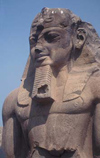
Yul Brynner playing Rameses II in The Ten Commandments (1956, Paramount Pictures), from Wikimedia Commons
Part of the dating problem is that the Bible never identifies the pharaoh of the Exodus by name, so dozens of candidates have been proposed based on many different factors of varying validity. The approach of our investigation is to try to ignore academic and religious traditions as much as possible. Then taking what the Bible does say at face value, go out and see if the evidence supports it or not. This avoids the problem of focusing on someone’s theory, when the theory does not really square with what the Bible is saying in the first place. If the Bible’s account is to be fairly tested we must use it as the starting point.
Skepticism about the biblical account of Exodus began to dominate academia when archaeological finds did not match the investigators view of biblical history. A major cause for this discrepancy was a new theory that had swept through the biblical archaeology world. This theory proposed that a proper understanding of the biblical account really pointed to the Exodus occurring not at the early date in 1400’s or 1500’s BC and not even in the 1300’s BC. This new theory designated the 19th Dynasty’s Rameses II, the most prolific builder of all time, as the pharaoh of the Exodus and this meant pushing the date for Exodus forward to around 1250 BC.
 Are the views of these prominent Egyptologists about the date of Exodus, supported by overwhelming evidence?
Rameses II as the antagonist who confronted Moses was soon seen everywhere from Hollywood movies, to school textbooks and even in the commentary sections of many Bible’s. But what was the basis for this popular thinking? Was Rameses II really the pharaoh of the Exodus?
The main factor that led many to arrive at the 1250 BC date, was the reference to the Israelite slaves building the store-city of Raamses in
Exodus 1:11. The only pharaohs named Rameses reigned after 1300 BC under conventional chronologies. Of these, only Rameses II was known to have built a city. Since his long reign took up most of the 1200’s, they reasoned that the Exodus must have occurred after the middle of his reign in about 1250 BC or after. To hold to this new convention, they had to ignore the other biblical data pointing to a much older Exodus given in the last two blog posts, as well as the majority view of previous generations of scholars.
 Video of David Rohl commenting on dating confusion
Early biblical archaeology, working from the viewpoint of a 15th century BC date, showed some promising finds related to the Exodus from Egypt and the conquest of Canaan. But the resulting searches in the new 1250 BC period came up with little evidence. Coupled with this was the evidence from this period that actually contradicted the biblical account. This fueled the trend toward biblical skepticism and it remains the prevailing view in academia to this day. However, many other lines of evidence show that the younger date of 1250 BC is in error and Rameses II was almost certainly not the pharaoh of the Exodus.
Here are the top ten reasons why Rameses II (reigning in the 1200’s BC under conventional chronology) was not the pharaoh of the Exodus:
1) A 1250 BC Exodus does not match the Bible’s chronology. Since
1 Kings 6:1 states that the Exodus occurred 480 years before Solomon’s 4th year, a 1250 BC Exodus would put Solomon’s 4th year at about 770 BC. Historical records, critics and religious traditions all agree that this is a much too recent date for Solomon. Rather, biblical and historical records combine to give Solomon’s 4th year an approximately 966 BC date and thus an Exodus about 1446 BC.
2) At least one pharaoh died between the building of the store-city of Raamses and the Exodus, so Rameses II couldn’t be the pharaoh of both events. The Exodus narrative mentions that the Israelites built a city called Raamses (
Exodus 1:11). But the same narrative has Moses being born after this (in chapter 2) and eventually fleeing from a pharaoh to Midian after killing the Egyptian taskmaster. After this, the pharaoh who was reigning at the time of Moses’ flight is explicitly said to have died in
Exodus 2:23 and
4:19. This is before Moses returns to Egypt to lead the Exodus. Therefore, Rameses II could not possibly be the builder of the city as well as the pharaoh of the Exodus.
3) Other factors in Moses’ story would necessarily push a Rameses II Exodus to 1150 BC. A second look at the timeframes involved in the Exodus account gives another reason to discount a 1250 BC date derived from Rameses II’s reign.
Exodus 2:2-3 has Moses’ birth occurring some years after the building of the store-city of Raamses (
Ex. 1:11,
15,
22). Moses was 80 years old at the time of the Exodus. This is based on
Deuteronomy 34:7 reporting his death at age 120 at the end of the 40 years of wandering in the wilderness (
Num. 14:33). So the Exodus must have happened more than 80 years after the building of Raamses. Since the city that Rameses II built is purported to have been constructed in the mid 1200’s BC, this would actually push the date for Exodus to at least the mid 1100’s BC in this scenario - a date so recent that even the most skeptical would hesitate to endorse it.

Monuments of Rameses II are the most numerous of any pharaoh
4) There is no archaeological or written evidence of anything related to the disasters of the plagues, the Red Sea drowning or a sudden and massive western Asiatic (Hebrew) slave exodus during the reign of Rameses II. This despite the fact that this era has the best recordkeeping of any in ancient Egypt. This problem also pertains to those scholars who postulate a related theory that Rameses II was the pharaoh of the oppression but his son Merneptah was the pharaoh of the Exodus. However, there are these types of evidences in an earlier chaotic period despite its few records. These will be dramatically highlighted in the film.
5) Rameses is referenced way back in Genesis 47. The Rameses II/1250 BC theory has another problem (that also applies to Merneptah). The Bible states that Jacob and his family settled in the “land” of Rameses way back in
Genesis 47:11 when Jacob entered Egypt. Throughout this section of Genesis, Goshen and Rameses are used interchangeably and seem to be geographic references not pertaining to any pharaoh. Significantly, in the biblical account, Genesis 47 took place hundreds of years before the store-city of Raamses was even built and, most would agree, hundreds of years before Rameses sat on his throne.
Scholars generally dismiss the Genesis 47 reference as an anachronism or a later updating of the text so the contemporary audience would understand what location was being discussed. According to one commentary, manuscripts of the Old Testament (Tanakh) copied before the First Century, do show evidence that the scribes were willing to revise or update the specific words of the text while preserving the accuracy. These two things are not contradictory because they assigned to the Scriptures a high degree of authority and upheld them with great reverence, but their desire was for the readers of their time to understand them (ESV Study Bible p. 2586). This would be like texts today saying that William the Conqueror crossed the English Channel in 1066 to invade England, while understanding that it wasn’t called the English Channel at the time and it wouldn’t be called that until around the year 1700. But if this is true, why couldn’t the
Exodus 1:11 reference also be a later updating?

Treating both “Rameses” references in the Bible equally, shows that they are both likely names that were updated after the original writing of the Exodus account, or at least had no necessary connection to the pharaoh named Rameses. This frees the Exodus from being tied to Rameses II for whom there is no compelling evidence for being the Pharaoh of the Exodus or the oppression and allows for further investigation around the earlier date derived from the Bible’s chronology and in periods that better fit the biblical narrative.
6) The Plagues, loss of army, and social collapse don’t fit the period of Rameses or Merneptah. The devastating effects of the plagues, the disaster at the Red Sea crossing and the sudden loss of the huge slave population on which their economy was largely based, argue against a 19th Dynasty Exodus. See the blog posting from December 21, 2009 for a closer look at this aspect. In view of this, the period to look for the Exodus is
not during one of the most glorious reigns of a pharaoh (Rameses II) in the middle one of the most prosperous and stable periods in Egyptian history (19th Dynasty) but rather during a time of social, political, economic and military collapse in Egypt. A 19th Dynasty Exodus does not fulfill this important criteria.
7) We have the mummies of Rameses II and Merneptah but the Pharaoh of Exodus was drowned at the bottom of the Red Sea. Some cite
Exodus 14:30, which states that, “Israel saw the Egyptians dead on the seashore" to postulate that Pharaoh’s body could have been recovered and returned to Egypt for burial.
The thinking that the drowning at the Red Sea would have been observed by other Egyptians, who brought the body back, is predicated on the assumption that the crossing occurred near Egypt. However, the internal geographical evidence in the Bible points strongly to the fact that the crossing was far from Egypt. See the blog entry from December 23, 2008 for details. The Bible claims that all of the Egyptian army went into the sea and all were drowned (
Ex. 14:23, 28) so there were none there to bring back his body from this isolated wilderness area. A Jewish historian from the First Century, Philo of Alexandria, wrote in On the Life of Moses, that there “was not even a torchbearer left to carry the news of this sudden disaster back to Egypt.”
 Was the body of the pharaoh recovered?
8) Pharaoh drowned in the sea but Rameses II reigned for 66 years and died at the ripe old age of 90.
Was the body of the pharaoh recovered?
8) Pharaoh drowned in the sea but Rameses II reigned for 66 years and died at the ripe old age of 90. No other pharaoh from this period lived even close to this age. A 90-year-old pharaoh would not have personally led a military campaign. His death in 1213 BC according to conventional chronology does not square with the 1250 BC theory or biblical chronology. Additionally, the text seems to indicate that the pharaoh of the Exodus had recently come to the throne before drowning at the sea (
Ex. 2:23,
4:19). One would expect the pharaoh of the Exodus to have a very short reign length of at most a few years and perhaps less than a year. This also applies to Merneptah, who reigned for a total of 10 years.
9) Rameses II and Merneptah did not die in the same year as their firstborn sons. According to the Bible, the pharaoh of the Exodus and his firstborn son died within a few weeks of each other. But Rameses II outlived his firstborn son, Amun-her khepeshef, by 42 years. Merneptah’s eldest son went on to reign long after Merneptah’s death. This does not match the Exodus account of pharaoh’s firstborn dying in the tenth plague.
Some scholars don't believe that the Bible claims that Pharaoh perished in the waters of the Red Sea. They point out that the term “pharaoh” can be used in place of the things pharaoh controlled. For instance, if the text says “pharaoh built a city”, it obviously does not mean that pharaoh himself personally built every brick of the buildings but that he had the city built by his work force. But here are some of the other facts we know about this case. We know from Exodus
14:4, 6 and 8, that Pharaoh personally led the army after the fleeing Israelites.
Many Egyptian sources describe various pharaohs leading their troops into battle and at least one was killed in battle. According to the belief that the pharaoh represented the power of the gods, it seems logical that he would personally lead the army. This also seems to be consistent with other kings and leaders. Joshua went with his army to fight in
Joshua 10:7, and the five kings of the Canaanites were also personally involved in the battle as seen in
10:16. The Israelite leaders in the book of Judges led their troops as did Saul who was killed with his sons in battle in
1 Samuel 31:1-6. The Philistine King Achish went to war with his troops as seen in
1 Samuel 28:1-2. Kings of Israel and Judah leading their forces into the battle can be found in
1 Kings 22:29-36.
Exodus
14:23 states that all of the Egyptian forces went into the sea after the people of Israel.
Verse 28 then says that all these forces that had followed the Israelites in, were drowned and that not one remained. In the victory song that was sung afterward in
Exodus 15:19, according to the Darby translation, it was sung, “For the horse of Pharaoh, with his chariot[s] and with his horsemen, came into the sea, and Jehovah brought again the waters of the sea upon them,” This point and the bracket comes from Dr. Glen Fritz who thinks that the Darby translation is closest to the Hebrew and that “with his chariots” (Hebrew: b’rekbo) should also be singular.
Some critics discount Exodus 15 because it’s a song. But this ignores the fact that in ancient times, songs and poetry were the main way that real historical facts were taught and recalled. As shown by the self-deprecating writings of Moses and the prophets, it was not meant to impose a favorable myth on the next generation. Philo and Josephus both concur that all were lost and
Psalm 136:15 reiterates that God “overthrew Pharaoh
and his army in the Red Sea.”
Additionally, the whole point of the themes of divine justice and retribution, and God getting glory over his enemies, would lose their punch if Pharaoh himself was not involved. Likewise, that God resists the proud and delights to humble those who lift themselves up; That those who thirst for blood shall have enough of it and those who love to destroy shall themselves be destroyed; For God said, vengeance is mine, I will repay. Rameses living a good long life after the Exodus just does not fit the narrative.

The Merneptah Stele in the Cairo Museum from Wikipedia Commons
under the Attribution-Share Alike 3.0 Unported license
10) The Merneptah Stela. Yet another strike against Rameses II or Merneptah being the pharaoh of the Exodus is the campaign of Merneptah in Canaan during his fifth year. On the commemorative stone known as the Merneptah Stele (or the Israel Stele) he claims a resounding victory over the people of Israel in Canaan. But according to the Bible, the children of Israel traveled in the desert after the Exodus before finally entering Canaan 40 years later. So Merneptah could hardly have been the pharaoh of the Exodus and then have defeated Israel in Canaan 5 years later. Even if Rameses II was the pharaoh of the Exodus (ignoring the wrong date and the fact that he should be at the bottom of the Red Sea), the fact that Egypt was able to mount a large-scale invasion of Canaan so soon after the Exodus does not match the biblical account. Moses stated that Egypt was still defeated 40 years after the Exodus in (
Dt.11:4) and a confrontation with Egypt is not listed in Joshua’s writings or those of the Judges despite the fact that these books are detailed accounts of Israel’s victories and defeats during that period.
Ramese II was not the pharaoh of the Exodus. The attack on the biblical record because of a lack of solid evidence for the Exodus and conquest in the 1200’s is unwarranted. Looking for evidence of these events in the 1200’s BC is like looking for evidence for America’s Revolutionary War happening at the end of the 20th century. However, when looking at the right time period, a strong pattern of evidence emerges supporting the Exodus. As will be seen in the film, the number and strength of these finds is overwhelming.
- Steve Law, Researcher for the Exodus Conspiracy
Taken from:
http://exodusconspiracy.blogspot.com/2010/03/was-rameses-ii-pharaoh-of-exodus.html